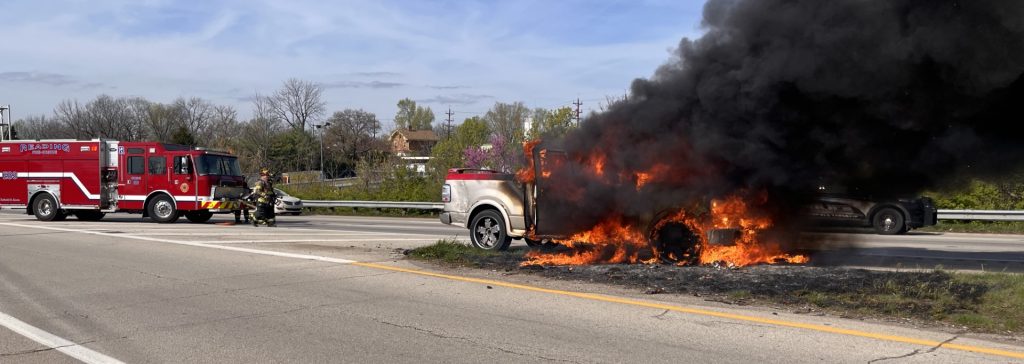
The Fire-Rescue Operations Division makes up the most significant portion of the agency and remains the bread and butter of the fire service. Reading operates on a three-shift system, with each working 24-hours on-duty followed by 48 hours off-duty. Each shift has 7 firefighter/paramedics or EMT’s. The Fire Department responded to over 3100 calls for service in 2024 with 80% being EMS related. Currently, we maintain an ISO class 2 rating.
Fire Suppression
Firefighting, while something we strive to reduce the frequency of, remains the foundation of our organization. Protecting the community from the ravages of uncontrolled fire is our top priority. Our firefighters are well-trained and well-equipped with the latest tools and tactics to make strategically aggressive fire attacks with practices that help us rapidly control structure fires.
All our engine companies are equipped with a minimum of 750 gallons of on-board water and more than enough supply fire hose to reach any fire hydrant located within the city limits. Fire attack lines are calculated to flow enough water to allow firefighters the ability to feel confident in their decision to be aggressive with their tactics. This ability to deliver higher water flows along with our closely coordinated ventilation skills allows our crews to safely search active fire buildings allowing any victims the most significant opportunity for survival.
Emergency Medical Services
All RFD units are staffed and equipped to support advanced life medical care. RFD provides emergency medical services to the City of Reading, Village of Arlington Heights, and Amberley Village. No matter the type of medical emergency, units will be dispatched, including enough personnel to manage the reported condition effectively, this is why you may see a fire truck responding to your request for medical care or an ambulance.
Emergency medical care is governed by standing orders and protocols established by the Academy of Medicine of Cincinnati.
All our patient information is confidential and protected by law under the “Health Insurance Portability and Accountability Act” of 1996.
Hazardous Materials
Reading firefighters are trained and equipped to deal with most of the more common responses such as gasoline spills and leaks involving natural and liquefied petroleum (LP) gasses. For any releases of large quantities of hazardous materials such as from a truck or railcar or which involve more complex chemicals, the department maintains a cooperative agreement with the Greater Cincinnati HazMat team, who will respond and work with us to resolve the matter.
Technical Rescue
Most firefighters in Reading maintain an operations capability in technical rescue. Operations level personnel respond to technical search-and-rescue incidents to identify hazards, use equipment, and apply the limited techniques specified in this standard to support and participate in technical search-and-rescue incidents. We do have firefighters trained to the technician (highest) level in technical rescue. These members are also members of the Hamilton County Urban Search & Rescue Team.